
ABOUT US
Welcome to the Abode
At Alkebulan’s Abode, our mission is to provide a sacred and supportive haven for melanated individuals seeking spiritual growth, cultural reconnection, and purposeful community. We are committed to facilitating access to ancestral knowledge, healing practices, and empowering experiences that help our people remember who they are and rise into their full potential. Through shared learning, creative expression, and collective care, we honor the legacy of our ancestors while building a liberated and spiritually grounded future.

BEKI KALUME - Founder & Executive Curator, Alkebulan’s Abode
Our Structure & Resource Philosophy
Alkebulan's Abode is intentionally not structured as a non-profit. We design initiatives, products, and experiences to generate sustainable income—not for extraction, but for co-creation. Rooted in the conviction that Africa's resources must be created, circulated, and sustained within Africa, we champion an Ubuntu economy where value flows back to communities.
To operationalize shared responsibility, 5% of all proceeds are allocated to our Community Support Responsibility (CSR) commitment. These funds are deployed transparently, with impact updates and evidence documented annually to ensure accountability, integrity, and measurable contribution to the ecosystems we serve.
-
Resource Sovereignty: Income generation designed to retain and reinvest value within African contexts.
-
Co-Creation Over Extraction: Programs built to empower, not exploit—centering African agency and ownership.
-
Ubuntu Economy in Practice: 5% CSR allocation reflecting our commitment to collective well-being and reciprocal growth.
-
Radical Transparency: Annual public reporting on CSR allocations, implementation, and documented impact.

MEET THE TEAM
Guided by Purpose, United in Spirit

Beki Kalume
Founder & Executive Curator, Alkebulan’s Abode
Beki Nazi Kalume is an International development practitioner and MEAL specialist with over a decade of experience across civil society, climate justice, governance, and community engagement in Africa. Holds a Master's in Project Planning and Management; brings expertise in policy advocacy, institutional strengthening, capacity building, and results-based programming to the Pan-African movement space.


Wisdom Kithome
Co-Founder | Creative Director & Digital Steward
Wisdom Kithome is a Cultural strategist and creative technologist with over fifteen years of experience spanning IT, media production, design, and organizational systems development. Trained at Jomo Kenyatta University, his work bridges technology, storytelling, and cultural infrastructure. As Co-Founder, he architects Alkebulan's Abode's digital presence and narrative coherence, ensuring the platform's Afrocentric vision is expressed through intentional design, sustainable systems, and purposeful content structures.

Humphrey Gitonga
Director of Finance, Audit and Compliance
Humphrey Gitonga Gatheru, is a Finance professional with over fifteen years of experience in accounting, auditing, regulatory compliance, and institutional financial systems. A Certified Public Accountant (CPA-K) with a background in Industrial Chemistry, he brings analytical precision and ethical stewardship to his work. At Alkebulan's Abode, he anchors financial governance and compliance while contributing to purpose-driven conversations on resource stewardship, ensuring growth honors both fiscal integrity and community-centered values.

Namia Jo'anne
Lead | Nazzy Teen Initiative
Namia Joanne is a young creative, aspiring scientist, and emerging youth leader passionate about storytelling, innovation, and celebrating Afrikan identity. As the Youth Lead for Nazzy Teen at Alkebulan's Abode, she helps shape engaging spaces where teenagers can connect, express themselves, and develop confidence while embracing their cultural heritage. She also contributes creative ideas to the organisation's digital storytelling and youth-focused initiatives, using media to amplify the voices of young Afrikans. Through her voluntary involvement outside school hours, Namia is developing the leadership, creativity, and entrepreneurial skills needed to inspire her generation to celebrate their roots and shape Afrika's future.

Kenyetta Overton
Partner | Melanated Tomorrow – Youth, Creativity & Leadership
Kenyetta Overton is a Multidisciplinary youth development practitioner, visual artist, and project manager whose work bridges education, creativity, leadership, and cultural grounding. Co-founder of The Murals of the Mind Project, she has served over 5,500 youth across the US, Ghana, and Kenya through culturally responsive STEAM and literacy programs. As a partner with Alkebulan's Abode, she integrates spiritual grounding, creative expression, and heritage-centered thinking into youth development, equipping young people to thrive while anchored in consciousness.

Anthony Bekuto Kalume
Lead, International Culture & Diaspora Relations | Elder Representative, Alkebulan’s Abode
Anthony Bekuto Kalume, is a Global curator and cultural connector dedicated to restoring Afrikan memory through museums, education, and community-led storytelling. Director of Diversity in Lewes (UK) and Founder of Culture Connection Project CIC, he is a UK Creative Communities Fellow and advocate for cultural repatriation. At Alkebulan's Abode, he provides intergenerational wisdom and strategic guidance, strengthening global relationships while ensuring ancestral knowledge is honored with integrity, dignity, and accountability.

Ngii Gichohi
Partner | Melanated Tomorrow – Children, Education & Wellness
Mwanaisha Ngii Gichohi is a Homeschooling consultant, wellness guide, and graphic designer whose practice centers on conscious living, holistic education, and embodied healing. An emerging children's author, she creates stories affirming African identity and emotional intelligence while supporting families in reconnecting with balance and self-trust. As a partner within Alkebulan's Abode, Ngii brings her passion for child empowerment, storytelling, and conscious upbringing to a collective space of remembrance, nurturing futures where African children are supported to fully become.

Cynthia Akinyi
Programmes, Partnerships & Resource Mobilization
Cynthia is a programmes and partnerships professional with a background in Communications and Public Relations, passionate about community empowerment, cultural stewardship, and building meaningful collaborations. As Programmes, Partnerships & Resource Mobilization Officer at Alkebulan’s Abode, she helps translate the organisation’s vision into impactful programmes while cultivating strategic partnerships and identifying resources that strengthen AAL’s work. With a strong focus on relationship-building and programme development, Cynthia connects people, ideas, and opportunities to expand the Abode’s reach and sustainability. Her work supports AAL’s mission of celebrating Afrikan heritage, strengthening communities, and creating platforms for meaningful cultural engagement.

Vannesa Chege
Communications, Brand Engagement & Networking Officer
Vannesa is a communications and brand engagement professional passionate about storytelling, meaningful connections, and creating visibility for purpose-driven work. At Alkebulan’s Abode, she leads communications, brand engagement, and networking efforts, helping translate the Abode’s vision into compelling narratives while strengthening relationships across its growing community and network. With a natural ability to connect people, ideas, and opportunities, Vannesa contributes to building a recognizable and authentic AAL presence across platforms and spaces. Her work supports the Abode’s commitment to cultural connection, collaborative growth, and amplifying Afrikan-centred stories with clarity, creativity, and purpose.

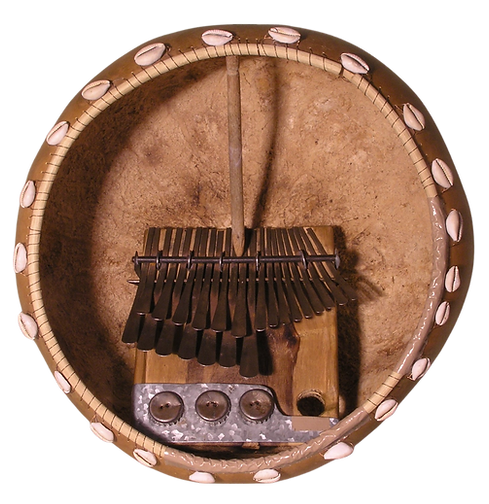
Long before notation or recording, the Shona people of Zimbabwe held conversations with the unseen through sound. At the heart of this dialogue was the Mbira, a vessel of remembrance.
Crafted from a wooden soundboard fitted with carefully tuned metal tines, the mbira is played with the thumbs and sometimes the forefingers, its shimmering tones rising like breath from the earth. Often paired with the rhythmic shake of the Hosho (gourd rattles), its music flows through ceremonies, rites of passage, and sacred gatherings as invocation.
To play the mbira is to open a channel. In Shona cosmology, its melodies call upon ancestral spirits (vadzimu), inviting their guidance, healing, and presence. Each composition carries lineage, some songs unchanged for centuries, passed hand to hand, ear to ear, heart to heart.
Musicologists may label it a lamellaphone or plucked idiophone, but to those who know its voice, the mbira is something deeper: a sonic archive, a spirit bridge, a living thread between past, present, and future.
Across Eastern and Southern Africa, many variations exist, each community shaping its own voice from wood, metal, and memory. Yet all share one truth: sound, when rooted in reverence, becomes remembrance.


The hosho are Zimbabwean musical instruments consisting of a pair of maranka (mapudzi) gourds with seeds
The hosho are Zimbabwean musical instruments consisting of a pair of maranka (mapudzi) gourds with seeds

PLAY

POWERED BY
NAZZY RECORDS
CHECK VOLUME
AUDIO ALERT

ABOUT US
Our Journey
Alkebulan’s Abode was born from a shared vision to create a sacred space where people of African descent could reconnect with their roots, rise in spiritual consciousness, and rediscover the power of community. The seed was planted on July 18, 2024, by our founder Beki Kalume - when along with a circle of pioneers - envisioned a home for melanated individuals on a path of awakening.
What began as a conversation blossomed into a movement—a vibrant, community-driven association grounded in African spirituality, ancestral wisdom, and cultural celebration. From the formation of our WhatsApp group to the development of powerful gatherings like Melanated Then, Now & Tomorrow (MTNT), our journey has been one of reflection, connection, and bold reimagination.
Each department of the Abode—from Heritage and Learning, to Healing and Creativity, to Youth Empowerment—marks a chapter in our collective story. And with every new member, workshop, and gathering, Alkebulan’s Abode continues to grow as a living sanctuary—uplifting, healing, and guiding our community into alignment with our past, present, and future.


PUNISHING THE TONGUE

THE BONE

THE BONE
LESSONS WE WERE TAUGHT NOT TO SPEAK
In many Afrikan schools, children were punished for speaking their own languages. The method was simple and devastating. A token, sometimes a carved disk, sometimes a piece of wood, sometimes a bone, was placed around the neck of the child caught speaking Kiswahili or mother tongue.
The object had to be passed to the next “offender.” Whoever held it at the end of the day was punished publicly. This was not merely discipline. It was a system.
By forcing children to police one another, language itself became dangerous. Fear traveled faster than authority. Shame became communal. Survival meant silence. The bone moved from neck to neck, not as correction, but as conditioning—teaching us that our tongues were liabilities, our words punishable, our inheritance something to escape.
Yet even then, language survived. It whispered in dormitories, laughed in playfields, lived in songs, jokes, and coded speech. What could not be spoken openly learned how to move underground.
This bone is a memory of violence—but also of resistance. It reminds us that what was forced into silence was never truly erased. We are still here. We still speak. We still remember.
NEWS
Alkebulan's Abode In The Press


